For a good stand
The entire musculoskeletal system and hooves go hand in hand. If the musculoskeletal system has been stressed too much, this affects the hooves and vice versa as well. The products for the support of the hooves and the entire musculoskeletal system can be found here. cdVet offers a variety of products for your pet.
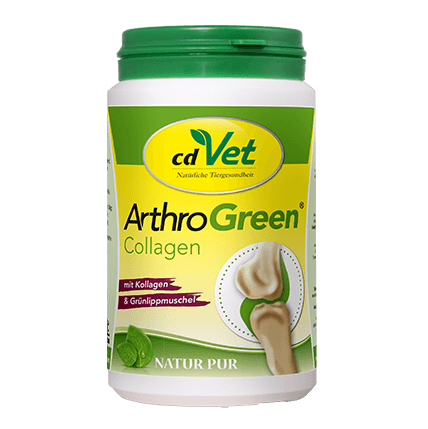
ArthroGreen Collagen 130 g
Complementary feed for dogs, cats and horsesFor nutrient supply of the joints with well utilizable collagen peptides and New Zealand greenshell mussel (non-defatted mussel meat), powderArthroGreen Collagen - so everything runs like a clockworkArthroGreen Classic was completed with well utilizable collagen peptides. This unique combination of greenshell mussel (non-defatted mussel meat), collagen, and metabolism-supporting herbs can, through the ingredients contained, strengthen the joints and increase their resistance to injury. Chondroitin sulfate, glucosamine glucans, collagen, and silicic acid can stimulate the self-regulation and regeneration of cartilage-forming cells.non-defatted mussel meat of the New Zealand greenshell musselimproved joint functionsincreased joy of movementmore quality of lifeComposition: porcine collagen hydrolysate 66.9%, New Zealand greenshell mussel (freeze-dried) 10%, grape pips meal, ginkgo leaves, devil‘s claw root, stinging nettle herb, field horsetail herb, sea buckthorn berries, spirulinaAnalytical constituents: crude protein 70.0%, crude fat 2.0%, crude fiber 3.95%, crude ash 4.45%, calcium 0.55%, phosphorus 0.15%, sodium 0.23%How to use: Add daily to the feed. Cats, dogs: 1 g/10 kg body weight. Horses: 5-10 g/kg body weight.1 half tsp. corresponds to approx. 1 g. 1 tbsp. corresponds to approx. 6.3 g.In case of particular strain, the feeding amount can be increased by half.
Content: 0.13 Kilogramm (€153.46 / 1 Kilogramm)
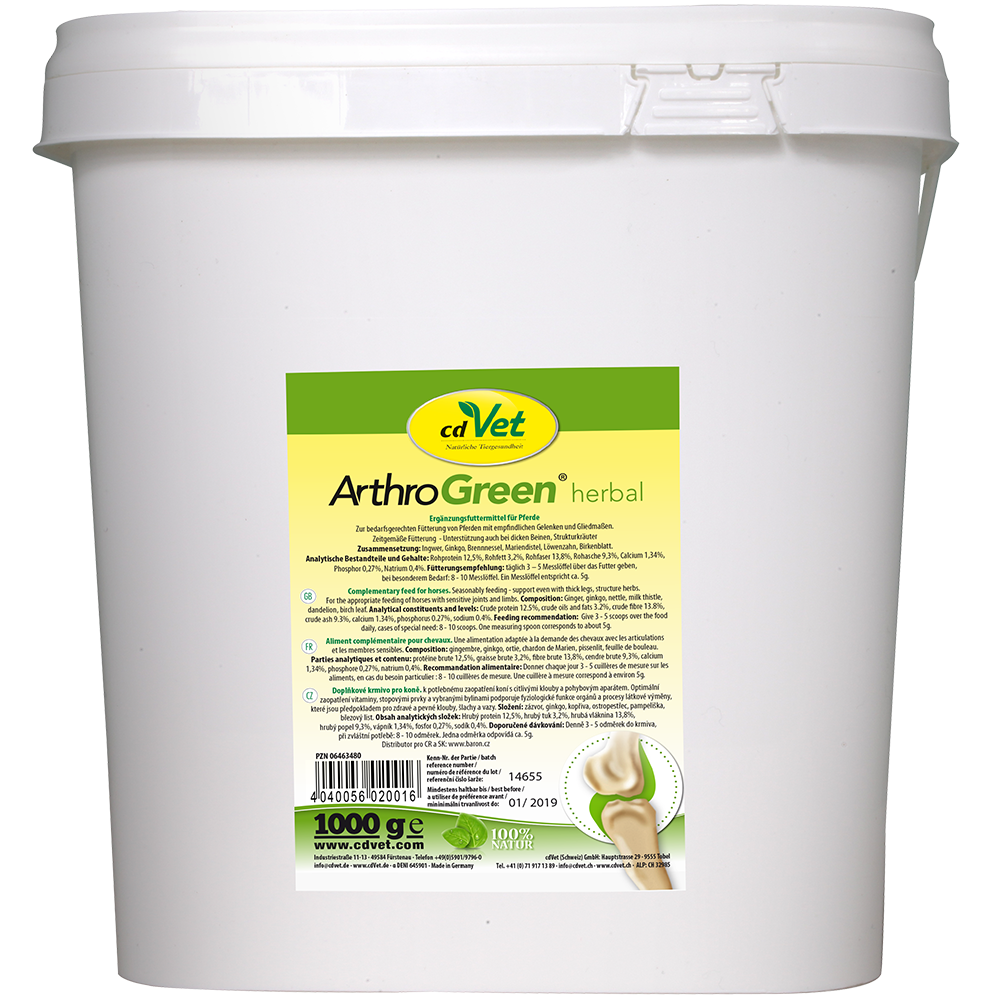
ArthroGreen herbal 1 kg
Complementary feed for horsesFor the demand-oriented feeding of horses with sensitive joints and limbsIntermittent feeding - support also for swollen legs, structural herbsThe minerals and essential oils contained in ArthroGreen herbal from purely natural sources can support the self-healing powers and improve the well-being of the horse.Improper nutrition and lack of exercise worsen the metabolic processes in the cartilage and thus its quality. In addition, there is a general age-related reduction in the activity of the metabolism in the entire organism. These processes lead to a deterioration in the quality of the cartilage and resulting to a reduction in the burden.ArthroGreen herbal addresses exactly this point and stimulates the connective and supporting tissue metabolism due to the high content of natural silicic acid. In addition, blood circulation is stimulated and faster regeneration is promoted. Together with herbs that support the liver and kidneys, toxins can be more easily eliminated from the body and fluid accumulations in the tissues can be promoted in their removal.Synergistic blend of herbsHigh silica contentSupports joint metabolismComposition: ginger, ginkgo leaf, birch leaf, stinging nettle herb, milk thistle herb, dandelion herb, dandelion rootAnalytical constituents: crude protein 12.5%, crude fat 3.2%, crude fiber 13.8%, crude ash 9.3%, calcium 1.34%, phosphorus 0.27%, sodium 0.4%How to use: Add daily 15-25 g/animal to the feed. In case of special need, the feeding amount can be doubled. 1 tbsp. corresponds to approx. ca. 2.5 g.
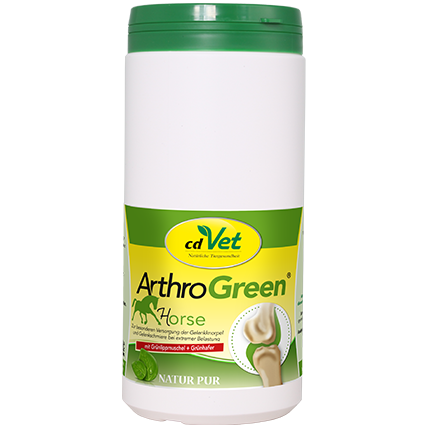
ArthroGreen Horse 700g
Complementary feed for horsesFor the appropriate feeding of joint-sensitive animalsSpecial supply of joints, muscles, tendons - with green lipped mussel, green oats and rose hip, powderThe new ArthroGreen Horse - optimized to meet the needs of horses as herbivoresWith improved acceptance and support of acid bases household!For more than a decade, the classic ArthroGreen has also been used with great success in horse feeding, but the sensitive herbivores differ greatly in digestive tract and metabolism from other mammals. In particular, the utilization of herbal ingredients is much better and the processing of animal feeds in turn is significantly worse than e.g. in dogs is the case.To meet these special requirements, the new ArthroGreen Horse was developed. For this purpose, the proven ArthroGreen basis has been optimized by metabolic and joint-supporting high-quality herbal ingredients for the nutritional needs of horses and ponies. ArthroGreen Horse has also been supplemented with acceptance enhancing green oats and valuable turmeric. Green oat is also known for its positive properties to regulate the acid-base balance, which can often play a crucial role in impaired joint function. Turmeric can be due to contained curcumin for self-regulation in case of dysfunction in the joint area.With green lipped mussels, rose hips, willow bark and co. included, ArthroGreen Horse is an all-round complementary feed that is particularly suitable for optimally supporting the musculoskeletal system and joints in significant phases in a natural way.Expert Tip: EquiGreen EquiMint is recommended for accompanying external care.Composition: ginkgo leaves, 15% New Zealand green lipped mussel freeze-dried, green oats 13,9%, rose hip peels 10%, devil‘s claw, nettle herb, horsetail, sand-buckthorn, spirulina, willow bark 4%, curcumaAnalytical constituents: crude protein 19.6%, crude fat 5.3%, crude fibre 11.4%, crude ash 8.5%, phosphorus 0.38%, calcium 1.46%, sodium 0.28%How to use: 30 g per day and animal. 1 coated measuring spoon corresponds to approx. 10 g.Contains fishmeal - shall not be fed to ruminants.
Content: 0.7 Kilogramm (€161.36 / 1 Kilogramm)
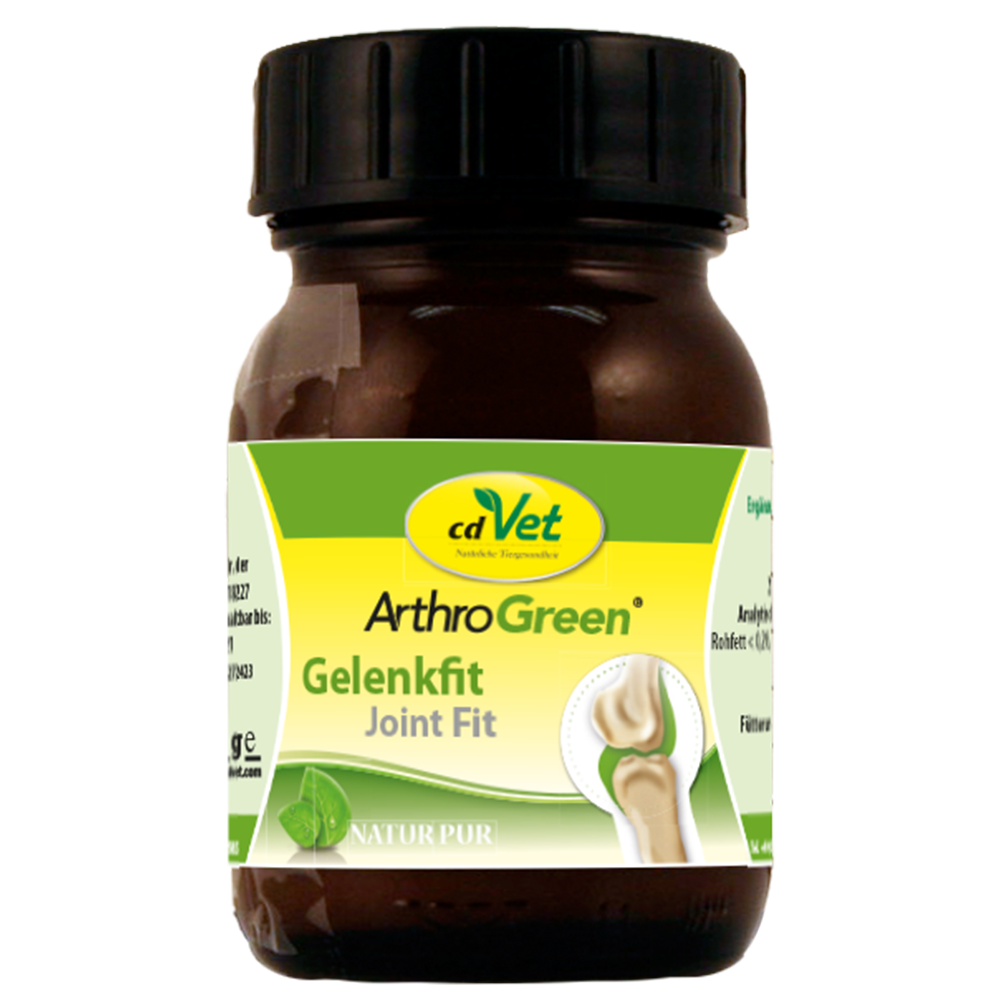
ArthroGreen Joint Fit 70 g
Complementary feed (powder) for dogs, cats and horsesComposition: dextrose, field horsetail herb, stinging nettle herb.Additives/kg: Technological additives: diatomaceous earth (E551c) 2.5 g.Analytical constituents: crude protein 0.3%, crude fat 0.2%, crude fiber 0.5%, crude ash 0.12%, sodium 0,02%.Feeding recommendations: Add to the feed 1 x daily for 2 months. Dogs, cats: 0.5-1 g. Horses: 1-2 g. 1 quarter tsp. corresponds to approx. 0.8 g.
Content: 0.07 Kilogramm (€699.29 / 1 Kilogramm)
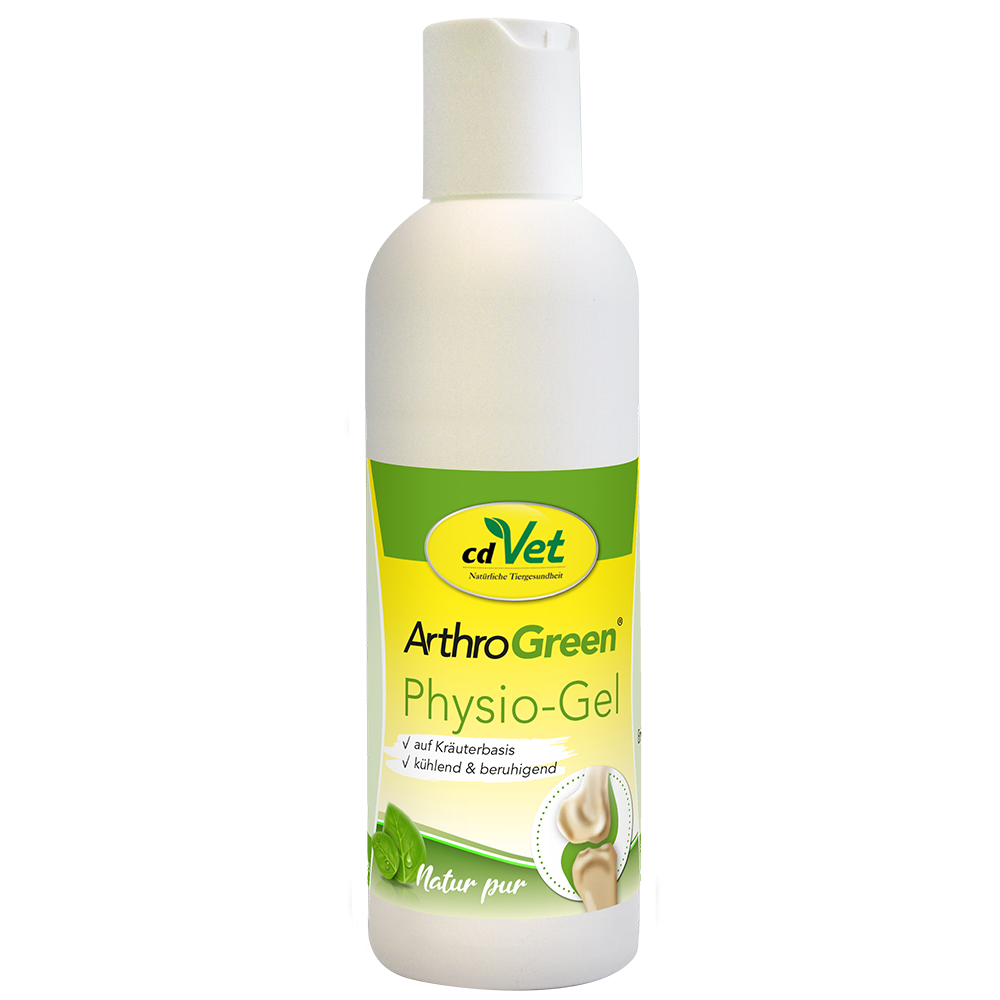
ArthroGreen Joint Gel 100 ml
Care product for animalsNatural care product based on herbs for supportive care in the joint area, cooling and soothingWhether it is the rampaging and playing young dog that falls over its own paws every now and then, or the young foal that cuts a caper in the paddock, or the elderly senior who can‘t quite get out of his basket or box in the morning. The joints have to do a lot, and every now and then they also have a bad day, and need a little bit of our support. Then how about a supportive, soothing care from the outside. ArthroGreen Joint Gel is easy to apply, and a boon for tendons, ligaments, and joints.Composition: aqua, natural emulsifier, peppermint oil, xanthan gum, marigold oil, eucalyptus oil, St. John‘s wort oil, jojoba oil, rosemary oil, green tea extract, arnica flower extract, gum arabicHow to use: rub thinly and evenly into the affected areas of the skin 2 x daily. Application duration: at least 3-8 days.Not suitable for cats !Contains 1,8-Cineole, L-menthan-3-one, Dipentene, Pin-2(3)-ene and d-Carvone. May produce an allergic reaction.
Content: 0.1 Liter (€159.50 / 1 Liter)
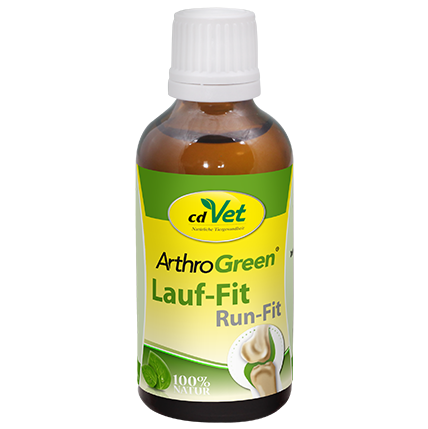
ArthroGreen Run-Fit 50 ml
Complementary feed (liquid) for dogs, cats, and horsesFor nutrition-related and therapy-accompanying support of the entire musculoskeletal system, especially in heavy use of the jointsArthroGreen Run-Fit is ideal for supporting the damaged joint apparatus in animals with osteoarthritis (also bone spavin and podotrochlosis in horses). This product contains highly active micronutrients and natural building blocks that help to maintain the musculoskeletal system.The ideal mixture of purely natural herbs in ArthroGreen Run-Fit makes a significant contribution to promoting the health of the musculoskeletal system and joints as well as reducing feeding-related deficiencies. This balanced blend of herbs with special bitter substances and flavonoids supports the health of the musculoskeletal system and joints. The natural salicin contained in ArthroGreen Run-Fit, which is metabolized in the body to salicylic acid, contributes in combination with circulation-promoting ingredients to support stressed joints. The careful composition promotes joint metabolism and counteracts the harmful effects of free radicals, which can affect cell structures. This support is particularly beneficial for age-related complaints such as osteoarthritis or intensive sporting activity.Composition: willow bark, devil‘s claw root, ginkgo leaves, arnica blossoms, horse chestnut blossoms, marigold blossomsAdditives/kg: Flavouring compounds: ethanol (2b02078) 62 g.Analytical constituents: crude protein 0.3%, crude fiber 0.5%, crude ash 0.4%, crude fat 0.2%, moisture 93%, sodium 0.02%How to use: Shake before use. Add to the feed as required or give directly into the muzzle. Cats: 0.5-1 ml/animal daily. Dogs: 2-4 ml/animal for at least 6 weeks 2 x daily. For year-round requirements: 1 ml/animal daily. Horses: 10 ml/animal for at least 4 weeks 2 x daily. For year-round requirements: 10 ml/animal 2 x daily. 10 drops correspond to approx. 0.3 ml. 1 tsp. corresponds to approx. 5 ml.
Content: 0.05 Liter (€239.00 / 1 Liter)
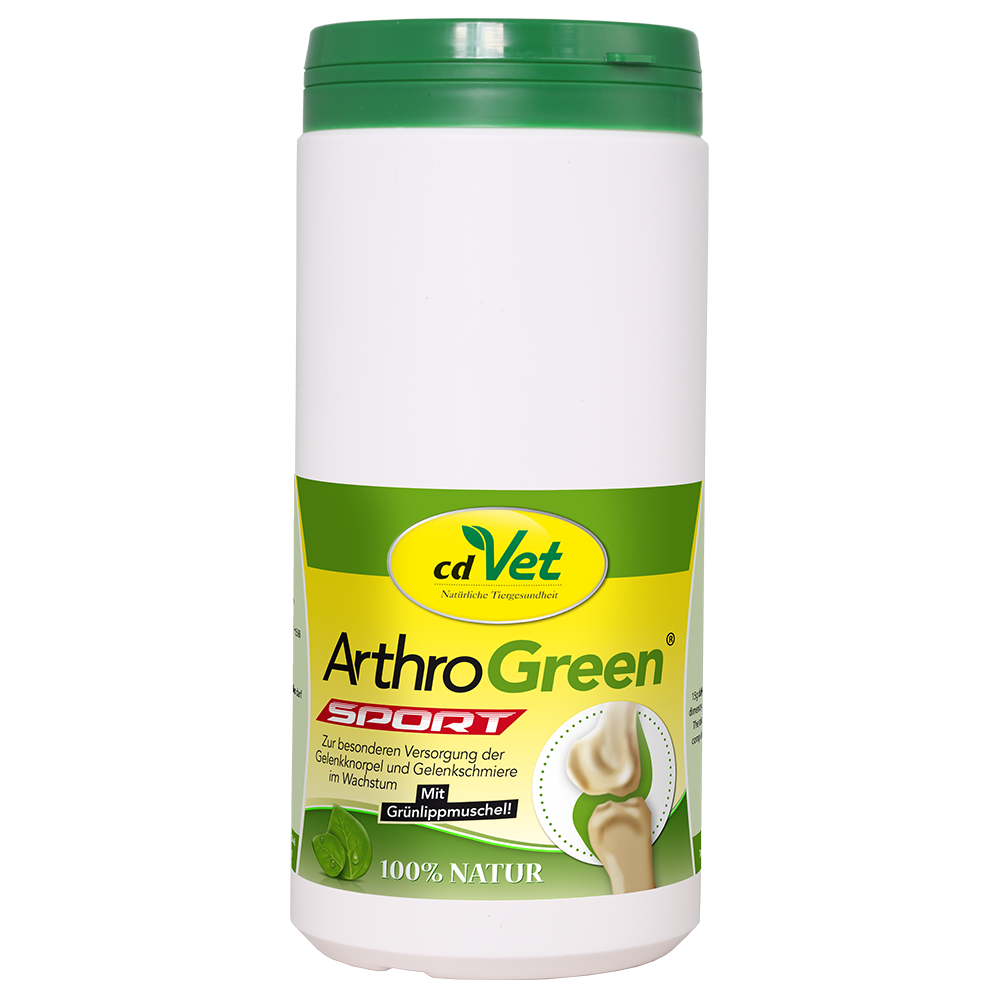
ArthroGreen Sport 700 g
Complementary feed for horsesFor demand-oriented feeding of horses in sport or growthNutrients for joints, muscles, and tendons - with green shell mussel, powderArthroGreen Sport seves to support joint metabolism and can nutrition-related contribute to the strengthening of tendons and ligaments as well as the strengthening of connective tissue.The glycosamine glycans contained serve as important building blocks for healthy, strong articular cartilage, and are supplemented by high-quality, natural radical scavengers. In addition, the high content of minerals, trace elements, vitamins, and essential amino acids is a valuable aid in case of increased need. Those are highly bioavailable and are characterized by their pH-value as favorable counterparts in case of overacidification. In addition, the ingenious composition can have a positive influence on memory performance and learning ability, respectively.for the support of the musculoskeletal system (the joints) in sport horses for feeding-specific support of young horses in the growth and/or training phasefor horses that are used in sports and have an increased need for vital substancesExpert tip: For micronutrient and mineral supply, the feeding of EquiGreen HuminoMineral is additionally advisable.Composition: grape pips meal, parsley, New Zealand greenshell mussel powder (freeze-dried) 15%, green oat, ginkgo leaves, rose hip husks, field horsetail herb, spirulina, sea buckthorn berries, turmericAdditives/kg: Technological additives: bentonite (1m558i) 10,2 g, clinoptilolite of sedimentary origin (1g568) 10,2 g.The total amount of bentonite must not exceed the permitted maximum level in complete feedingstuff of 20000 mg/kg of complete feedingstuff. Total quantity of clinoptilolite of sedimentary origin from all sources shall not exceed the maximum content of 10000 mg.Analytical constituents: crude protein 20.4%, crude ash 8.9%, crude fat 4.1%, crude fiber 18.7%, ash insoluble in HCl 4.0%, calcium 0.91%, phosphorus 0.41%, sodium 0.41%How to use: Add daily 15 g/animal to the feed. 1 tbsp. corresponds to approx. ca. 6.5 g.The simultaneous oral use with macrolides shall be avoided. Contains fishmeal - shall not be fed to ruminants.
Content: 0.7 Kilogramm (€132.79 / 1 Kilogramm)
EquiGreen Back of the Pastern Spray 50 ml
Care product for horsesSpray for daily care of the back of the pasternsEquiGreen Back of the Pastern Spray cares for and protects the irritated, stressed skin of the horse. Via milieu-improving ingredients, the self-regulation is strengthened and the colonization of pathogenic microorganisms and fungi on the skin is impeded. Nourishing oils and sea salt soothe the skin and contribute to faster regeneration. EquiGreen Back of the Pastern Spray reduces itching and chafing and can, therefore, be used as an adjunctive therapy for malanders and abrasions, as well as for skin irritations in the tail or mane area.reduces itchingstrengthens the skin microbiomenourishes and protectspromotes regeneration and stabilizesComposition: aqua, liverwort, rockrose, savory, Dead Sea salt, emulsifier, Egyptian organic black cumin oil, marigold, lavender oil, Aloe vera, frankincense oil.Application recommendation: apply on the cleansed skin areas 2 x daily.Contains lavender oil. May produce an allergic reaction.
Content: 0.05 Liter (€299.00 / 1 Liter)
EquiGreen Capped Hock Fluid 200ml
Care product for horsesNatural herbal extract for problem-oriented skin careThe capped hock is a swelling at the point of the hock. It is often just a cosmetic problem, but can potentially cause lameness. The care with herbal tinctures can support the regression of newly arising capped hocks. Furthermore, EquiGreen Capped-hock Fluid has caring and vitalisating properties also during existing capped hock which can be helpfully for the body´s owned regeneration power. As a valuable nutritional support to EquiGreen Capped-hock Fluid ArthroGreen herbal is recommended.Composition: combination of herbal extracts based on alcohol with extract of horse chestnut, birch leaf and arnicaDirections for use: rub into the affected skin daily, never use any other cleaning agents at the same time, never cover or bandage the affected skin during the application period, apply EquiGreen Capped-hock Fluid with gauze or cotton cloth in the problem area.Store in cool and dark place!
Content: 0.2 Liter (€189.75 / 1 Liter)
EquiGreen EquiMint 100 g
Care product for horsesBlood flow circulation of muscles with essential oilsBlood circulation is a key factor in the operation of all body functions. Only where blood flowis the body is able heal itself. EquiGreen EquiMint provides the skin with nourishing and caring substances and aids the blood circulation, without making the skin brittle. EquiGreen EquiMint is particularly nourishing, refreshing and soothing. It absorbs quickly into the skin and leaves no residues on the coat. Blood circulation is important: - for bruises - for the respiratory system - for sore muscles - for tensions - for stressed joints - for haematomas - for the excretion of waste productsComposition: with ethereal oils (peppermint, calendula, eucalyptus, tea tree).Recommendations for use: Rub a thin and even layer into the affected skin twice a day for at least 3 - 8 days.
Content: 0.1 Kilogramm (€139.50 / 1 Kilogramm)
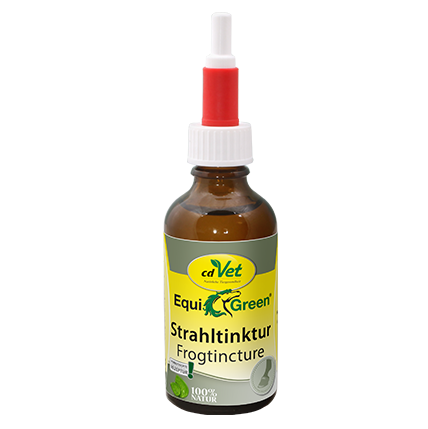
EquiGreen Frog Tincture 50 ml
Care product for horsesNatural care product for intensive cleaning in case of problems in the frog area of the hooves, also at thrushAt thrush, a rotting-like dissolution of the hoof frog occurs. It is caused by lack of cleanliness and care of the hooves, especially by standing in the damp manure.In order to protect horses from a new disease, a clean stable, as well as dry litter (EquiGreen HuminoVet granulate / powder) should be self-evident.Composition: alcohol, aqua, Melaleuca alternifolia oil, Polysorbate 20, Calendula officinalis extract.Application recommendation: Apply regularly on the frog and in the furrow.Shake before use!
Content: 0.05 Liter (€279.00 / 1 Liter)
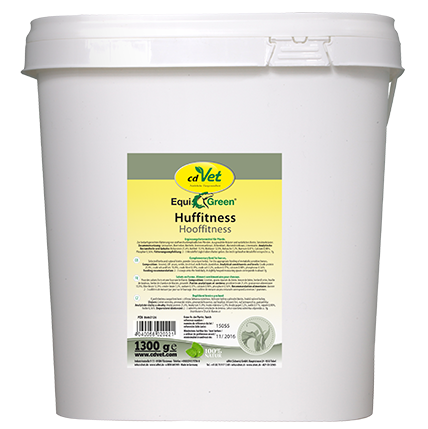
EquiGreen Hoof Fitness 1.3 kg
Complementary feed for horsesFor demand-oriented feeding of horses sensitive to metabolism - selected herbs and natural biotin, structural herbsAn optimal supply of vitamins, trace elements, and selected herbs supports the physiological organ functions and metabolic processes that are necessary for healthy hoof growth, among other things. EquiGreen Hoof Fitness nutritionally-related promotes healthy hoof growth through valuable herbs, essential vitamins (especially B vitamins - biotin), as well as minerals, and gives the horse a beautiful and shiny coat.For an additional micronutrient supply EquiGreen MicroMineral is recommended.promotes healthy hoof growthwith valuable B vitamins and biotinalso for horses sensitive to metabolismComposition: linseed, brewers’ grains, brewers’ yeast, stinging nettle herb, birch leaves, milk thistle herb, dandelion herb, dandelion root.Analytical constituents: crude protein 21.4%, crude fat 15.9%, crude fiber 12.9%, crude ash 7.2%, calcium 0.98%, phosphorus 0.56%, sodium 0.17%.Feeding recommendation: Add daily 15-20 g/animal to the feed. 1 tbsp. corresponds to approx. 5 g.
Content: 1.3 Kilogramm (€25.35 / 1 Kilogramm)
There are various measures that can be taken to relieve muscle tension in horses. A gentle massage can help to loosen the muscles and promote blood circulation. Heat applications, such as warm compresses or infrared therapy, can help relax the muscles. Targeted physiotherapy exercises can also improve mobility and reduce tension.
Osteoarthritis in horses can manifest itself in various ways. Common symptoms are lameness, stiffness, a change in gait, especially after periods of rest, and difficulty getting up or lying down. The horse can also be sensitive to touch in the affected joint area. Other signs can include reduced performance, an erect coat and behavioral changes such as unwillingness to perform certain movements.
A horse can show pain in various ways. Common signs are lameness, changes in gait, restlessness, increased sweating, loss of appetite, teeth grinding, raised fur, adopting unusual postures and a sensitive reaction to touch in the affected area. Behavioral changes such as increased aggressiveness or resignation can also indicate pain.
To effectively build muscle in horses, a balanced combination of regular training, appropriate nutrition and adequate rest is crucial. Intensive but gradual training that targets different muscle groups promotes the development of strength and endurance. A protein-rich diet is important to support muscle building. This can be easily covered with EquiGreen Sensitive Protein. At the same time, horses need sufficient rest periods to regenerate muscles. An individually tailored training program, careful care and a balanced diet are key components to promote healthy and strong muscle building.
Knee problems in horses can manifest themselves in various ways. Common symptoms are lameness, swelling, a feeling of warmth in the knee area, stiffness, difficulty bending or straightening the knee, and a change in gait. The horse may show discomfort when walking, which increases with exertion. If knee problems are suspected, a thorough veterinary examination is important to determine the exact cause and initiate appropriate treatment measures.